If you don’t where it is, you can’t protect it.
Do you know where ALL your organisation’s data is – not physically, but on which web and cloud services?
Here’s the problem. If you don’t where it is, then you can’t protect it. The secondary problem is finding out, because not everyone in your organisation will be onboard. It is common for people to sign up to web services because they offer something useful that helps them do their job.
They sign up using their email address and creating a password. There is the first headache – how does anyone track what has been signed up to across your organisation, let alone who has access to it? If that person leaves, no one will change the account credentials if they don’t know about it, but your ex-colleague still has access.
Secondly, what data do they upload? Is that data that you have a legal or moral responsibility for?
There’s nothing noble about Nobelium.
This isn’t theory – it’s real. USAID is a pretty important US organisation – promoting democracy and human rights around the world. Turns out, someone there was using a well-known email database tool called Constant Contact. But their account wasn’t well protected. Worse still, their account had a huge mailing set up, and of course, it had all the official USAID templates.
So, these Nobelium people, allegedly a Russian state-sponsored hacker group, compromised the Constant Contact account and sent a bulletin out. The bulletin contained malware that allowed the hackers to take command and control over victims computers. Ironically the fake email alleged interference in the US federal elections.
So, what can you do?
The first step is knowing what SaaS tools your people are using. We call this SHADOW IT and it is inevitable. Rather than stopping it, the job IT has is to identify it and manage it. The second step is to secure those platforms. That’s why our KARE for Security S2 plan contains a useful tool to help you identify what services your people are using.
Refer : What We Know About The Apparent Russian Hack Exploiting USAID : NPR

The Cybercrime Gang That Sends People Through Your Front Door
Silent Ransom Group phones staff pretending to be IT support, and when that fails, sends someone in person with a USB drive.

What Is Fable 5? Why Can’t You Access It Any More?
Why Anthropic switched off Fable 5 and Mythos 5 after a US export control directive, the timeline, and what it means for businesses.
Webinar Replay: Unpacking Your Microsoft Secure Score
What Microsoft Secure Score measures, why it changes, and how to use it as a practical security roadmap.

Where Do You Start With AI?
A practical three-stage AI journey for NZ businesses: experiment, put governance in place, then operationalise.

NVIDIA’s Latest AI Announcements. Should You Pay Attention?
NVIDIA’s DGX, Vera and Cosmos announcements in plain English, and what they signal for businesses.
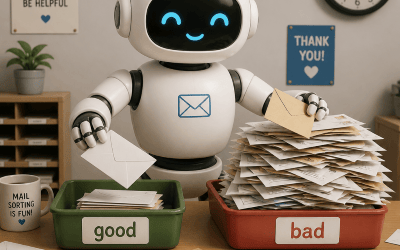
Sent Isn’t the Same as Delivered: When Your Own Emails Get Blocked
A legitimate booking link in an email signature suddenly got emails quarantined, with no warning. What happened and what it means for you.

We Asked Our Hardware Supplier About “Next Business Day” Warranties. The Answer Wasn’t Great
“Next Business Day Onsite” warranties cover the response, not the repair. What they really mean and how to protect critical devices.
The Google Change That Could Cut Your Website Traffic Overnight
Google’s AI Overviews answer questions on the results page, so fewer people click through. What’s changing and what to do now.
Webinar Replay: Microsoft Copilot Updates, Agent Mode, Claude and Tasks
A practical 30-minute look at Copilot Agent Mode, Claude in Copilot, Cowork and two small features with a big impact.

Is Apple’s AI Reboot Anything to Be Excited About?
Apple Intelligence takes a different approach to AI: built in, on-device and personal. What’s here now and what’s coming.