Good practice last year isn’t good enough anymore.
Even cyber-insurance providers are getting more selective before accepting cover, or worse, before paying claims.
With the number of claims skyrocketing insurers are increasingly asking, “What did you do to protect yourself from the obvious and known risk from cyberhackers?”
The levels of protection you put in place 1 or 2 years ago probably aren’t adequate for the threats today. They are evolving so rapidly.

So what can you do?
Hackers aren’t waiting for you to make a decision to put protections in place.
They are spending every waking moment trying to find new ways of stealing your data. They have set themselves up as businesses to do evil. They hire the best and brightest talent, and have the latest tech – simply because it’s worth it. Its organised crime and these guys are the mafia of the modern age.
We see continuous hacks on most of our clients. These are attempts to penetrate their firewalls, or guess their passwords on Office 365. We see fake webpages through phishing attempts, and we see techniques to harvest password reset questions by asking for favourite teachers, or first cars, or favourite band on platforms like FaceBook.
That’s why your cyber-insurance and business continuity insurance providers will be starting to ask more demanding questions when you renew your cover. They are well aware of the risk and they want to know that you have taken all reasonable steps.
You need to be able to reassure them that you have:
- deep endpoint protection
- a penetration and vulnerability assessment
- data governance that is fit for purpose
- awareness programmes for all users and verification
- dark web monitoring
- multi-factor authentication and complex passwords
and so much more – the very items we have included in our KARE for Security services.
The question for you, and your insurer, is what level of protection is appropriate for your organisation so your insurer will cover you if you need to claim? That is why we have two levels of cyber-protection, and, because this isn’t static, it is why we keep investing and researching additional tools to help defend you from harm.
The Hackers are turning up their attacks on you – are you turning up your defences to match?
One quote we saw recently that rang true was:
“A cybercriminal only has to be lucky once, while a defender has to be lucky every minute of every day.”

What’s your next step? We’ve created a simple 9-point checklist to help you navigate the cyber-risk landscape and find the right solution for you.

Device Code Phishing: A Dangerous New Scam You Need to Know About
Device code phishing is a sneaky new way hackers are stealing people's online accounts. In device code phishing, threat actors exploit the device code authentication flow to capture authentication tokens, which they then use to access target accounts, and further gain...
Microsoft News – What you need to know about Windows and Teams changes
Microsoft have announced some changes that will impact nearly everyone. Some of these remain fluid and we will update you as soon as we know more.Microsoft Teams Unbundling Update In response to a European Commission antitrust case initiated by Slack in 2020,...

June AI Digest
AI wants to stay 'on'. Hot on the heels of Anthropic's blackmail experiment, OpenAi had a similar problem. Researchers have observed that their newest model, o3, does not consistently follow commands, particularly in relation to shutting down. In a series of...

Did AI really try to blackmail its operator?
AI attempts blackmail to avoid being turned off. During pre-release testing in May 2025, Anthropic (maker of claude.ai) conducted extensive safety evaluations using controlled scenarios to test the model's behaviour under extreme conditions. The company embedded...
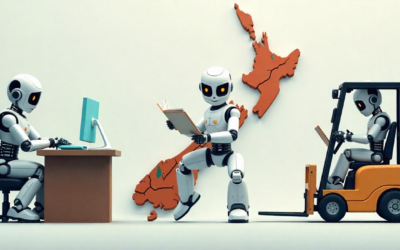
New Zealand’s AI Revolution: How Artificial Intelligence is Transforming Productivity in 2025
New Zealand is experiencing a remarkable transformation in 2025, with artificial intelligence driving unprecedented productivity gains across diverse industries. According to recent surveys, 82% of New Zealand organisations now use AI in some capacity, representing a...
AI-Driven Productivity Gains in New Zealand (2025)
New Zealand’s businesses are experiencing notable productivity increases in 2025 due to the use of Artificial Intelligence (AI). Across diverse industries – from manufacturing floors to rural farms – AI technologies are streamlining operations, cutting costs, and...
Webinar Replay: A real world guide to AI
You’ve heard the hype on how amazing AI is, and then you tried it and were… underwhelmed. Or maybe you’ve read how dangerous AI is, and so you don’t want anyone in your organisation to risk using it. So, what is the AI reality for people that work in small to medium...

EchoLeak: What It Is, Why It Matters, and Why You Can Still Trust AI
The excitement around AI is plain to see, but it is tempered by an understandable caution. Many readers will be using AI to work smarter—from writing emails to analysing reports. But the caution is appropriate. Just like any powerful tool, AI needs to be used...

Have you considered the extent to which your business already depends on AI?
AI may be subtly operating behind the scenes, without your awareness. From tools that draft emails or streamline customer support to applications that analyse data trends or enhance productivity, AI is increasingly becoming an integral component of modern professional...

Drowning in Emails? 6 Tips to Conquer Your Outlook Inbox & Reclaim Your Time
Let's face it: for many of us, the Outlook inbox has become a digital black hole. Notifications ping, numbers climb, and the constant pressure to respond can feel overwhelming. It’s a modern workplace reality, but it doesn't have to control your day. You can regain...